Dear Church Family,
What a blessing to know our goal for online shoeboxes was almost reached on day 1! Thank you for your continued generosity in all things. I know you are a church that gives of your time, money, and prayers for the sharing of the Gospel. Speaking of the Gospel, someone from our church was ministering to a neighbor and this neighbor happens to be very ill, but wanted to be baptized. He had never understood the Gospel, so after sharing with him, he believed and I baptized him right then and there! May God continue to give us opportunities. God is so good.
I read this devotional and thought it would bless you—
Moses spent forty days on a mountain receiving the blueprint for a tent.
Every board, every colour, every piece of furniture, “exactly as I show you.” (Exodus 25:9)
Fifteen centuries later, the New Testament says why the details mattered so much: the whole structure was a shadow cast by a Person.
Here’s the Tabernacle read as a portrait of Christ, detail by detail.
First, why read it this way at all? Because the New Testament tells us to.
Hebrews says the priests served as “a copy and shadow of the heavenly things,” and that Moses was told to build “according to the pattern.” (8:5)
Paul says these things were “a shadow of the things to come, but the substance belongs to Christ.” (Colossians 2:17)
A shadow has the same outline as the thing that casts it, but it isn’t the thing.
And John opens his Gospel with this: “The Word became flesh and dwelt among us.” The verb is ἐσκήνωσεν -eskēnōsen – “pitched His tent.” Tabernacled.
The tent in the desert was the outline. Jesus is what cast it.
Start with what you’d see from outside.
The Tabernacle had four layers of covering. (Exodus 26)
The innermost was beautiful – fine twisted linen in blue, purple, and scarlet, woven with cherubim. Only the priests inside ever saw it.
The outermost was plain and tough: animal skins. The Hebrew word is uncertain; translations range from “goatskins” to “durable leather” to “badgers’ skins,” but everyone agrees it wasn’t beautiful.
So from the camp, the dwelling place of God looked like an ordinary weathered tent in the desert.
Isaiah described the coming Servant the same way: “He had no form or majesty that we should look at him, and no beauty that we should desire him.” (53:2)
Plain on the outside. Glory within.
Now look at what the furniture and walls were made of.
Acacia wood, overlaid with pure gold. (Exodus 25:10–11; 26:29)
Acacia is a tough, thorny desert tree whose wood grew out of the dry ground of the wilderness. Gold was the material of royalty and of God’s own glory.
Not gold-coloured wood. Not wood with gold decoration. Real wood, completely covered with real gold, both fully present in a single object.
Christians since the early church have seen in this a picture of who Jesus is: fully human, grown up “like a root out of dry ground” (Isaiah 53:2), and fully God.
Exodus doesn’t spell that interpretation out; it’s a classic Christian reading.
But it’s hard to design a better visual for two natures in one person.
Inside, the only light came from the lampstand, and the way it was made is striking.
It wasn’t cast in a mold or assembled from parts. It was “of hammered work,” beaten out from a single talent of pure gold. (Exodus 25:31, 39)
The light of God’s dwelling was produced by a long process of blows.
And its cups were shaped like almond blossoms. (25:33)
The almond is the first tree to bloom in the Land of Israel each year; the Hebrew name, shaqed, is related to the word for “watching” or “awake.” It was the first sign of life after winter.
Light that came through being beaten. Shaped like the first blossom of spring.
“I am the light of the world.” (John 8:12)
Opposite the lampstand stood a golden table with twelve loaves of bread on it. (Leviticus 24:5–9)
Its Hebrew name is lechem ha-panim, usually translated as “bread of the Presence,” but literally “bread of the face.”
Twelve loaves, one for each tribe of Israel, set out continually “before me,” God says. (Exodus 25:30)
Every tribe was represented before God’s face at all times, day and night, even when no one from that tribe was in the room.
That’s exactly what Hebrews says Jesus does now: “He always lives to make intercession for them.” (7:25)
Before the Father’s face, at all times, every one of His people is represented.
You are never absent from the room.
Behind the veil stood the Ark of the Covenant. Hebrews tells us what was kept inside it: “a golden urn holding the manna, and Aaron’s staff that budded, and the tablets of the covenant.” (9:4)
Three objects. Look at them together.
The tablets of the law – the commandments Israel broke, and Jesus kept perfectly.
The manna – bread from heaven. “I am the bread of life… the living bread that came down from heaven.” (John 6:35, 51)
Aaron’s staff – a dead, dry stick of wood that, overnight, “sprouted and put forth buds and produced blossoms, and it bore ripe almonds.” (Numbers 17:8)
A perfectly kept law. Bread from heaven. And dead wood that came back to life.
The Ark carried the whole story of Christ in a box.
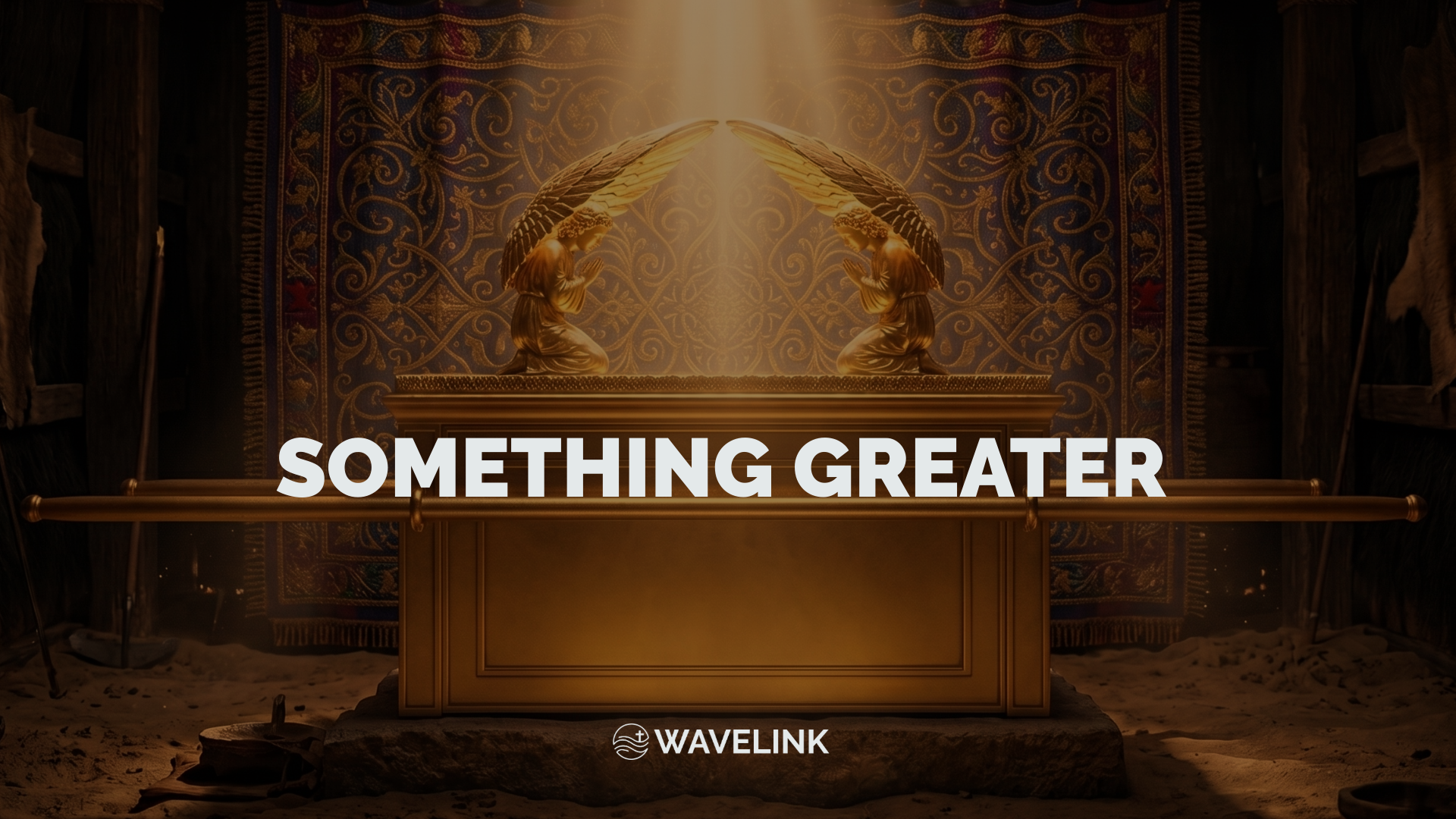
On top of the Ark sat the mercy seat, the golden lid, with a cherub at each end, facing each other. (Exodus 25:18–20)
Once a year, blood was sprinkled on it, between the two cherubim. It was the meeting place between a holy God and His people. (Leviticus 16:14–15)
Now fast-forward to Easter morning. Mary Magdalene looks into the empty tomb and sees “two angels in white, sitting where the body of Jesus had lain, one at the head and one at the feet.” (John 20:12)
An angelic figure at each end. And between them, the place where His body and His blood had been.
John doesn’t explain it. He just records what she saw.
But for anyone who knew what sat behind the veil, the empty tomb looked very much like a mercy seat.
The Tabernacle as a portrait of Christ:
1. A shadow cast by a Person – “the substance belongs to Christ”
2. Plain skins outside, glory within – “no beauty that we should desire him”
3. Acacia wood overlaid with gold – fully human, fully God
4. A lampstand of hammered gold, shaped like the first blossom of spring
5. The bread of the face – every tribe always before God
6. The law kept, bread from heaven, and dead wood that budded
7. Two angels at the head and foot of the place where He lay
For fifteen hundred years, Israel carried this tent through the desert and then built it into stone.
It was always a picture of someone coming to live among them.
And then He did. “Something greater than the temple is here.” (Matthew 12:6)
Press On!
Mark
Upcoming Events